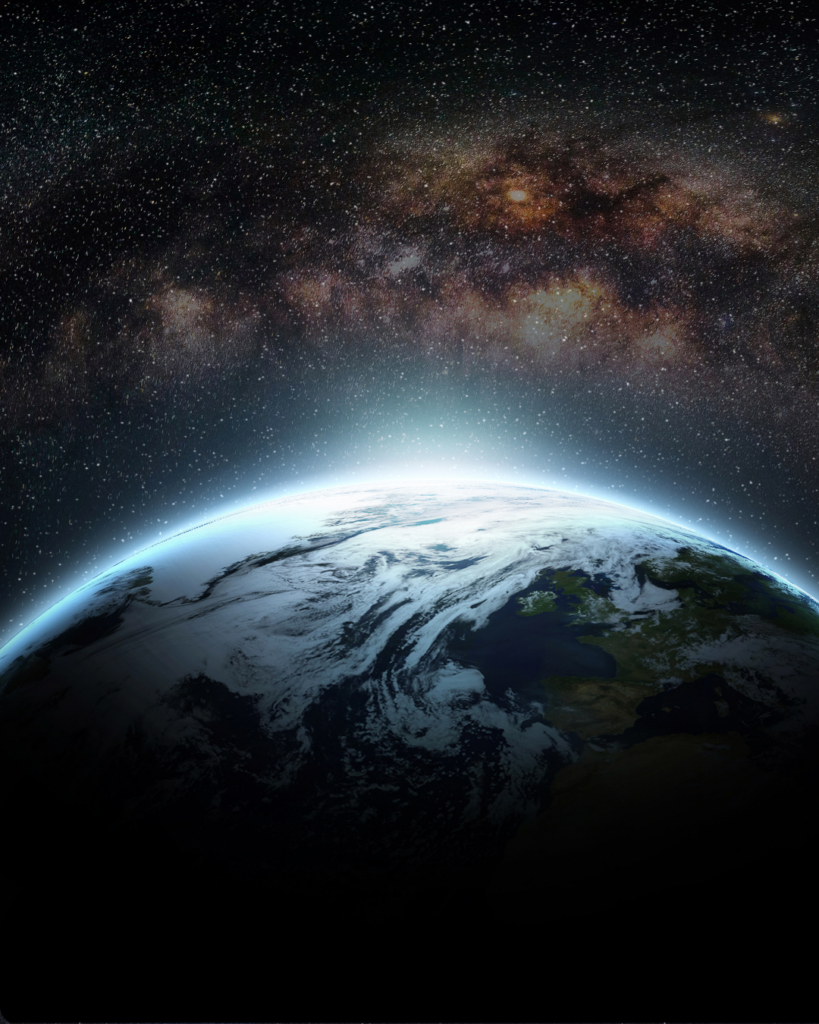
When and how did it all begin? What was the first cause that we can point to as the origin of the Universe and life? We have a lot of people to be thankful for who have helped us better understand this subject over time. For me, three in particular. Without becoming too scientific or overly technical, what we do know beyond reasonable doubt is that the Universe did have a definite beginning.
The three I refer to are; Sir Issac Newton (1643-1727) the greatest English mathematician of his generation. His laws of motion and the Law of Universal Gravitation remain the basic principles of physics today. Albert Einstein (1879-1955) who is best known for his theory of General Relativity which proved an absolute definite beginning for time, space, and matter. He also predicted an expanding Universe. This assumption was confirmed by the American astronomer Dr. Edwin Hubble (1889-1953), who also discovered other galaxies beyond the Milky Way.
While natural science (including the study of biology, physics, and astronomy) explains how the Universe and life operate, it cannot fully explain the origin of the Universe. Yet by inductive reasoning of some of our most intelligent astronomers, physicists and astrophysicists, there is enough observational astronomy available, that when taken with the 12 fundamental Laws of Physics (for the most part), it seems to confirm we have a Universe that had a definite beginning and therefore requires an Artificer/Creator. Bottom line, there is no substantive evidence (currently), for anything other than creationism.
Dr Alfred Edersheim (1825–1889) was a believer in the oldest of monotheistic faiths (Judaism) until his conversion to Christianity—he would later become a renowned biblical scholar. He wrote in his book, Bible History—Old Testament; “The first verse in the book of Genesis simply states the general fact, that ‘In the beginning’—whenever that may have been—God created the heavens and the earth. Then, in the second verse, we find earth described as it was at the close of the last great revolution, preceding the present state of things.”
A couple of comments regarding the second verse in Genesis. Some portions of ancient Hebrew as a language can seem challenging and the word HAYAH is one of those words. It is a substantive verb used to connect the predicate with its subject. It is mostly used here in Genesis in a “come or came to be” sort of sense, like in Genesis 1:3; “God said let there be light and there was light” – in other words, “God said let light come to be and light came to be”. So, to me, this second verse is better read as: “The earth came to be (not just was) without form and void; and darkness on the face of the deep … “. This reading of Genesis chapter one, verse 2 also gives scope for all geologic ages.
What can we imagine bought about this desolation described by Moses in verse 2—to leave the Earth “without form and void.” Possibly today some 6,000 years later (if you believe in a young Earth), it is best envisioned as what would happen to Earth following a nuclear explosion. We are told there would be huge amounts of soot in the stratosphere, that space about 50kms above the Earth which would block out the Sun for up to a decade! A period described as a nuclear winter. The Earth would be without form and void which doubtful anything or anyone would survive.
Can I prove to you unquestionably that the first cause in the creation of the Universe was God? The answer is no I can’t because I wasn’t there to witness the first cause resulting in what we can now see. Two trillion galaxies in a multiple of colours, each galaxy having ~ 100 billion stars along with planets, moons, asteroids, comets and clouds of dust and gas—all swirling in the vastness of space.
In summary, most of us believe what we believe based on our current environment, learnings and life experiences, a sense of belongingness and our spiritual needs—what gives our life a sense of meaning. To me all this starts with an inquisitiveness in how did it all begin and consequently a belief in a transcendent, intelligent, and active Creator outside space and time; this to me is the most persuasive explanation. I take the accounts in the Bible; cosmological and biological evidence like DNA; what I see around me in nature, and pure logic—all this is what I base my faith in God on.
The renowned American philosopher and poet Ralph Waldo Emerson summed up the science-faith connection this way; “All I have seen teaches me to trust in the Creator for all I have not seen.”